
when the next task changes the rules
a message arrives while you are checking a spreadsheet. the new request uses a different date, a different source and a different definition of “done.” switching well starts with noticing what changed.
that is the question behind the research in this guide: how accurately do people respond when the task or rule changes? it is also one reason we chose to pair caffeine with l-theanine in workflow.
what is task switching?
imagine sorting a set of items by color, then being told to sort them by shape. the material may be familiar, but the rule has changed. you have to notice the new instruction and apply it to the next answer.
that is a simple illustration of the question researchers ask. a controlled switching task lets them count correct responses and response times. moving from a spreadsheet to a message is more complicated, but the distinction helps explain why “i feel awake” is not a complete measure of attention.
what did the attention-switching studies find?
three selected human trials found benefits on attention-switching tasks with caffeine + l-theanine. they tested defined ingredient amounts against placebo, with different testing schedules. the table keeps the amount and the outcome together.
these are ingredient studies, rather than trials of finished workflow gummies. the two 2010 trials did not include caffeine-only conditions, so their results do not establish whether adding theanine outperformed caffeine alone.
| study + participants | amounts + comparison | attention result |
|---|---|---|
| giesbrecht et al. · 2010 · 44 young adults | 40 mg caffeine + 97 mg l-theanine versus placebo; testing at 20 and 70 minutes | better task-switching accuracy and reported alertness; visual search, choice reaction time and mental rotation did not improve significantly |
| einöther et al. · 2010 · 29 adults | 40 mg caffeine + 97 mg l-theanine versus placebo; test batteries began at 10 and 60 minutes | better switch-task accuracy without a significant reaction-time improvement; subjective alertness and intersensory attention did not improve significantly |
| owen et al. · 2008 · 27 participants | 50 mg caffeine, with or without 100 mg l-theanine, and placebo; testing at 60 and 90 minutes | the combination improved attention-switching speed and accuracy versus placebo at 60 minutes; less distracting-information interference in the memory task at 60 and 90 minutes |
a more accurate answer can matter without a faster one
the einöther trial is a useful example: participants gave more correct responses on the switch task without a significant change in reaction time. the accuracy result was not simply a trade of slower answers for fewer mistakes.
the same trial did not reduce its measured switch costs: the extra difficulty immediately after a rule change. better performance on a switching task and eliminating the cost of switching are different claims. that is why the actual outcome matters more than a broad promise to multitask better.
what kind of focus does your task ask for?
checking the right source, noticing a changed instruction and staying with a long list ask different things of your attention. start with the part of the task you care about, then look for the research measure that matches it.
for a draft, your next checkpoint might be a complete argument. for a spreadsheet, it might be matching every input to its source. these are practical ways to define good work; they help you ask a more useful question than whether a product offers “more energy”.
| what you want to understand | what to look for in a study |
|---|---|
| fewer wrong answers | an accuracy measure |
| quicker responses | a reaction-time measure |
| handling changing instructions | a switching task |
| staying with a repetitive task | a sustained-attention task |
bring the pairing to your work + study routine
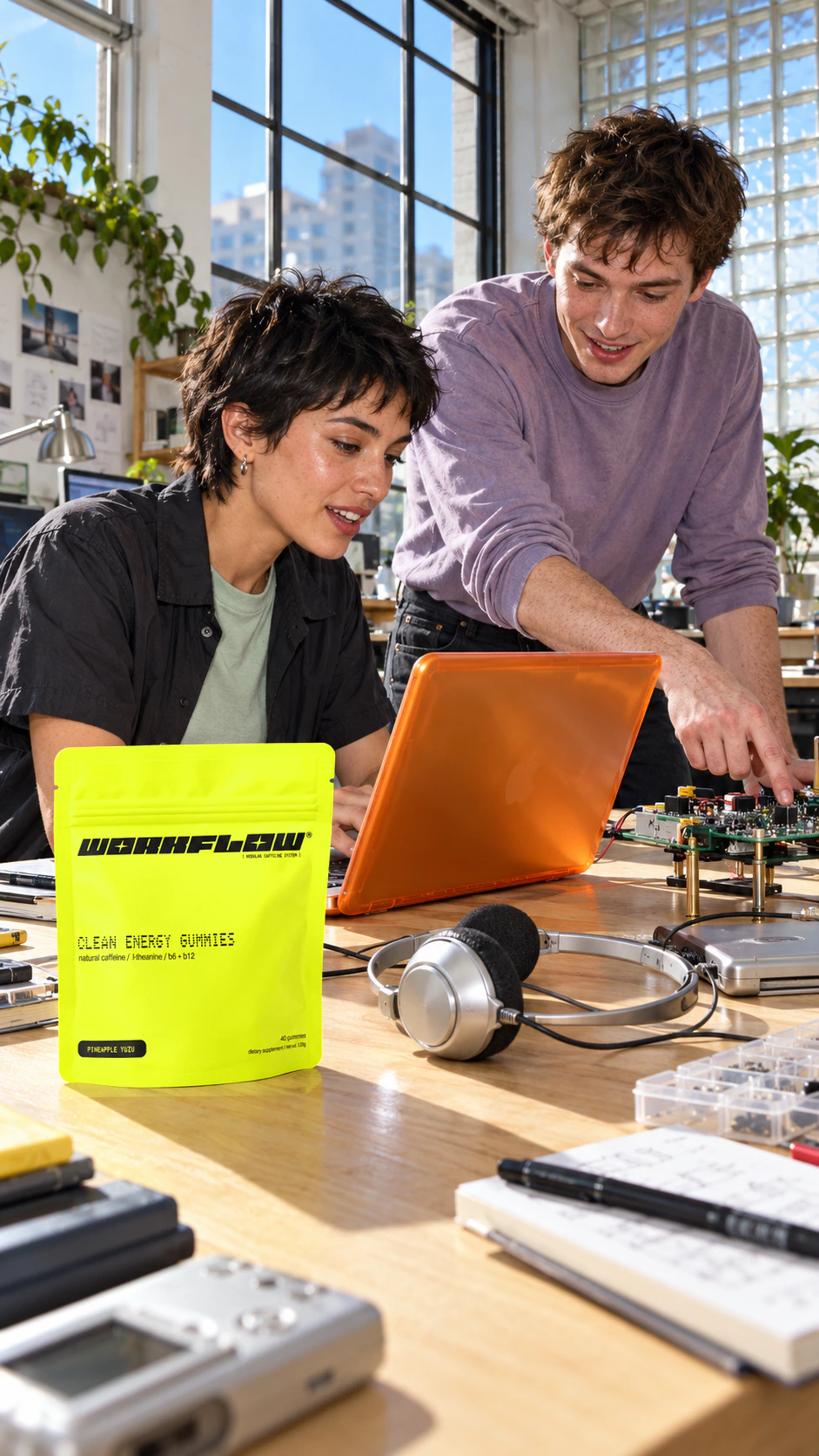
workflow is for the next chapter, the next draft and the work between them. every gummy pairs 20 mg caffeine from guarana with 40 mg l-theanine. one gummy is the label serving, with 40 gummies in a pouch: a small, countable caffeine choice with both ingredients already together.
choose pineapple yuzu or blood orange mango. keep the pouch with your work essentials when you want a caffeine + l-theanine option without brewing a drink or carrying a separate theanine product. follow the pouch directions and include other caffeine in your total.
give the task a clear place to resume, too: leave the current instruction and your next action visible before you move on. our work-session guide walks through a practical setup for that next block.
[ TAKE IT WITH YOU ]
look for the right answer, not just the fast one
[ GOOD QUESTIONS ]
a little more clarity
does feeling more alert mean being more accurate?
not necessarily. self-reported alertness and correct task responses are different measures. look for the outcome that matches your question.
does task-switching research mean better multitasking at work?
it shows how participants performed on controlled tasks with changing rules. selected caffeine + l-theanine trials found better accuracy, and one also found faster responses. a laboratory switching result is not a test of doing two real work tasks at once. use the study’s named outcome when comparing focus claims.
how much caffeine and l-theanine is in each gummy?
each workflow gummy contains 20 mg caffeine from guarana and 40 mg l-theanine. both flavors use the same core formula, with 40 gummies per pouch.
sources & further reading
original studies, product labels and references used in this guide.
written by workflow. follow the product label. send a question or correction.